The Canada Casino Central analytical team regularly receives questions about gambling taxation. Several years have passed since the launch of the province’s regulated market in April 2022, and now, in 2026, the financial rules of the game have become extremely transparent. We have analysed the current tax code and payout practices at top platforms to give you an accurate, fact‑based answer on how to keep your winnings.
Quick Summary

Legal Status of Gambling in Ontario
To understand the tax framework, it is necessary to consider how the industry is structured in the province. By the end of 2026, the Ontario market has firmly established itself as the safest and most tightly regulated zone for players in North America. The main oversight body here is the Alcohol and Gaming Commission of Ontario (AGCO), while day‑to‑day management is handled by its subsidiary, iGaming Ontario (iGO). Ontario gambling tax laws clearly distinguish between corporate taxes paid by companies and personal taxes paid by users.
Operators that obtain a local licence are required to remit approximately 20% of their gross gaming revenue to the provincial budget. This is precisely why iGaming Ontario tax for players does not exist as such: the system is structured so that the province has already received its share from the game organiser. The player does not need to pay any additional fees when withdrawing funds from a legal site.
Playing in the regulated Ontario sector is significantly safer from a tax authority scrutiny perspective. iGO‑licensed operators provide transparent transaction statements. If you win a large jackpot, it will be easy for you to prove the legitimacy of the transfer to your bank, which is not the case with offshore platforms.
Ontario Laws vs Rest of Canada
Although the basic federal legislation exempts winnings from tax across the country, Ontario operates within its own “sandbox.” In other provinces, the monopoly on online gambling belongs to state corporations (for example, Loto‑Québec or BCLC), and private brands exist in a grey zone. In Ontario, any independent brand can legalise itself.
This means that when you withdraw money to a bank account in Toronto or Ottawa, your local bank sees an official iGO partner, not a suspicious foreign processor. This dramatically reduces the risk of account freezes due to money laundering suspicions.
Gambling Tax: Who Needs to Pay?
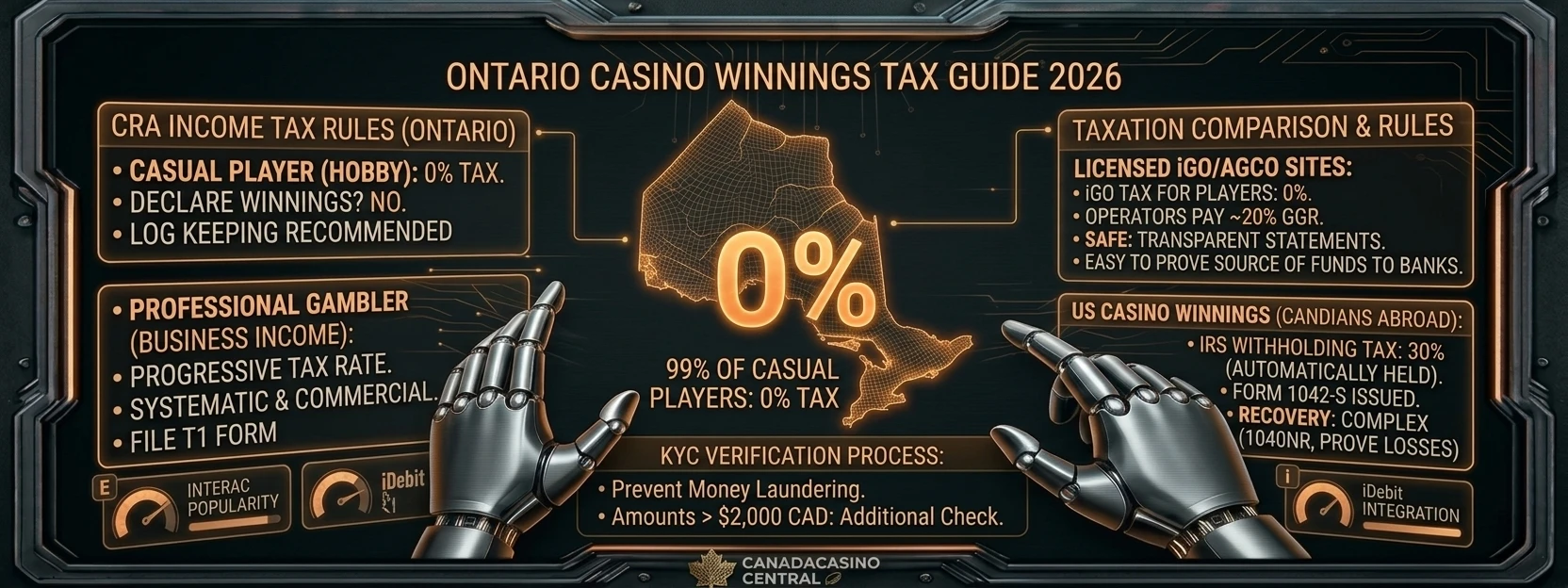
The most important question on gamblers’ minds is whether one must pay tax on winnings in Canada in the current year. The official position of the Canada Revenue Agency (CRA) remains unchanged: lottery, casino, sports betting, or poker winnings are not considered taxable income unless they qualify as business income. CRA gambling winnings Ontario rules divide all users into two broad categories: casual players and professionals.
Below we break down the taxation of gambling in Ontario 2026 for both groups, so you know exactly where the legal line lies.
Casual Player Exemption
For 99% of people, gambling is entertainment. If you visit an online casino after work, spin slots on weekends, or occasionally play in poker tournaments for fun, the CRA considers you a casual player. Your winnings depend on chance, not on systematic effort.
The key term here is “expectation of profit.” A casual player does not structure their personal budget around guaranteed roulette winnings. Consequently, Ontario online casino income tax does not apply to you, and you do not need to declare these amounts on a T1 form.
Professional Gambler Criteria
A completely different situation arises when gambling becomes your primary profession. The concept of professional gambler tax Ontario applies to those whose activity is systematic and commercial in nature. The tax authority analyses several factors: frequency of play, use of specialised analysis software (especially in poker or blackjack), the share of winnings in the household budget, and professional training.
If the CRA determines that your activity is a business, the standard income tax on lottery and gambling Canada comes into effect. Your net income (winnings minus losses and related expenses, such as internet or software purchases) will be taxed at progressive rates, like a salary or sole proprietor profit.
| Type of Income | Tax Rate in Ontario | Filing Required |
|---|---|---|
| Slot winnings (casual) | 0% | No |
| Ontario lotteries (OLG) | 0% | No |
| Poker tournament income (professional) | Progressive (as income) | Yes (T1 form) |
Playing at Licensed Ontario Online Casinos
In 2026, Canadian players can choose from dozens of trusted brands. Platforms such as Vavada, Duel, Vodka Bet, Spinbetter, and Cat have adapted their financial systems to the province’s strict requirements. Playing on these sites ensures maximum financial transparency, which is critically important for trouble‑free interactions with tax authorities.

Welcome Bonus
N/ARakeback 50%

Welcome Bonus
100%Up to C$1000

Welcome Bonus
100% + 30FSUp to C$450

Welcome Bonus
125% + 50FSUp to 300FS

Welcome Bonus
100% + 100FSUp to C$500
The main advantage of licensed sites is automated record‑keeping and the use of local banking gateways. You do not need to worry about hidden fees or complex currency conversions that might confuse your accountant.
CAD Deposits and Withdrawals
A key factor for residents of the province is playing on so‑called Loonie Casinos that support the Canadian dollar as the primary account currency (True CAD Support). The absence of double conversion (CAD–USD–CAD) not only saves you 3‑5% on bank spreads but also makes tax reporting crystal clear.
Using national systems such as Interac allows operators to instantly transfer winnings directly to your bank account. For the CRA, this appears as a legal domestic transfer within the country.
Verification and Reporting
Under 2026 regulator rules, every licensed online casino is required to conduct a strict Know Your Customer (KYC) procedure. This is done not to impose Ontario casino winnings tax, but to prevent money laundering and protect minors.
The standard process for receiving a large payout is as follows:
- The player submits a withdrawal request.
- Security checks for any rule violations (e.g., multi‑accounting).
- For amounts exceeding 2,000 CAD, additional identity confirmation is requested.
- The transaction is sent through an approved banking gateway marked “Gambling Winnings.”
Ontario vs US Casino Winnings
Many Ontario residents regularly cross the border to play at US establishments or play on platforms based in the United States. It is important to understand that tax jurisdiction changes depending on where the server or casino where you hit your jackpot is physically located. The US tax system (IRS) is radically different from Canada’s and considers all gambling a taxable base.
This creates legal complications for Canadians accustomed to a zero rate at home. If you play within your own province, you have nothing to worry about, but when you enter the US market, entirely different withholding mechanisms come into play.
Withholding Tax Rules
If a Canadian resident wins a substantial amount (typically over 1,200 USD on slots) in the United States, the casino is required to automatically withhold 30% in favour of the IRS. This is the standard withholding tax. You will be issued Form 1042‑S documenting this fact.
Canadians have the right to recover some or all of that 30% if they can prove their losses to the IRS (by filing a US 1040NR return). However, this is a complex bureaucratic process. This is why playing at licensed online casinos within Ontario is mathematically more advantageous – you receive 100% of your money immediately, without the need to deal with foreign tax authorities.
Frequently Asked Questions
No, if you are an ordinary casual player. Gambling winnings in Canada are not considered income. The only exception is professional players for whom gambling is a primary source of earnings (business income).
There is a nuance here. The win itself at a crypto casino is not taxable. However, cryptocurrency in Canada is treated as a commodity. If you won 1 BTC and held it, and then its value rose sharply before you exchanged it for CAD, that price increase may be subject to capital gains tax.
No. The regulatory model in Ontario is structured so that all taxes and licensing fees are paid by the online casino operators themselves out of their gross profits. Players receive their winnings in full without any provincial or federal deductions.
This is a standard anti‑money laundering (AML) financial monitoring procedure, not a tax audit. You need to log into your casino account, download a detailed statement of deposits and withdrawals over the past several months, and provide that document to the bank to confirm the legal source of the funds.