Quick Summary
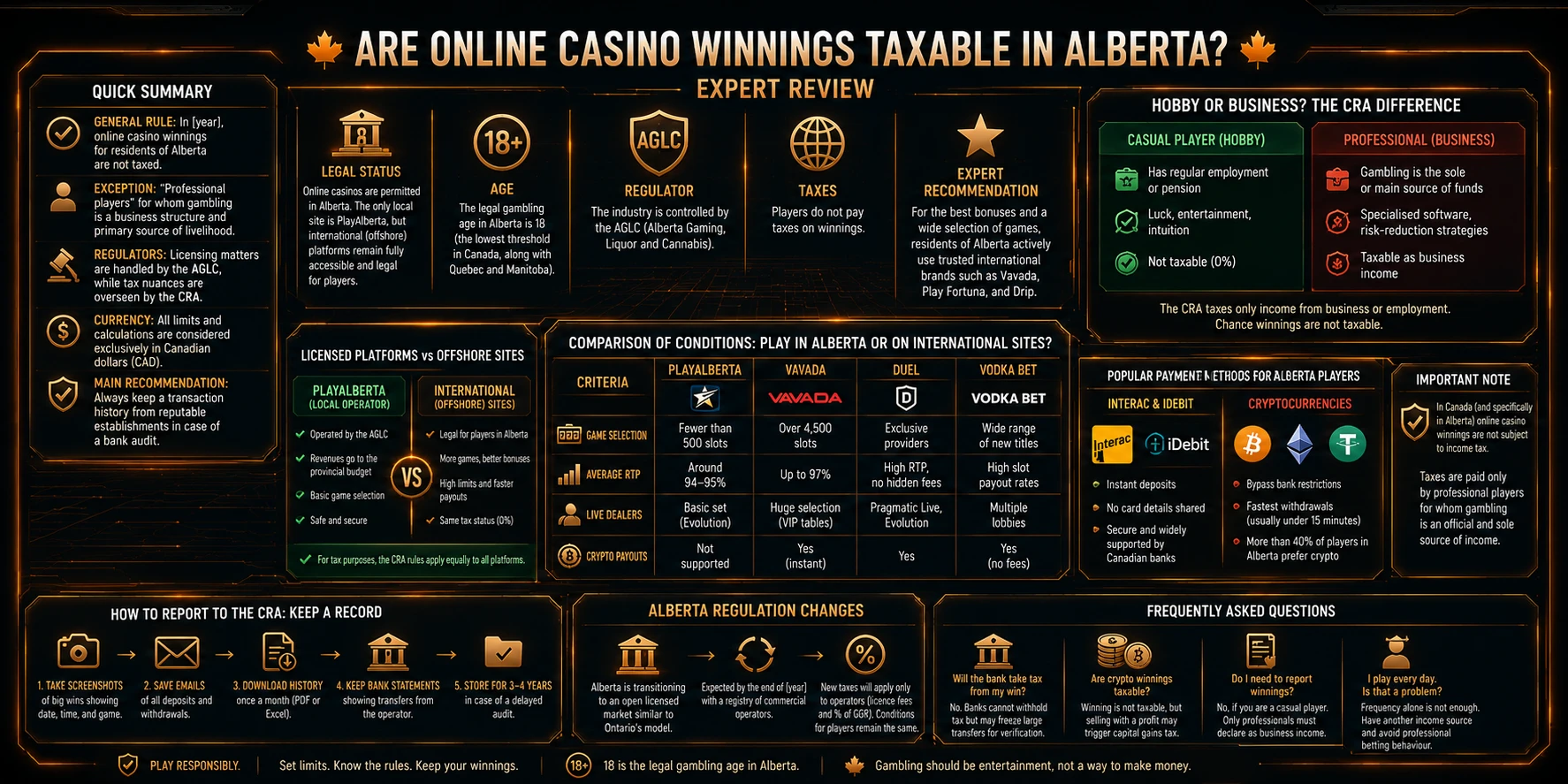
- General rule: In 2026, online casino winnings for residents of Alberta are not taxed. They are treated as a matter of luck, not stable income.
- Exception: “Professional players” for whom gambling is a business structure and primary source of livelihood.
- Regulators: Licensing matters are handled by the AGLC, while tax nuances are overseen by the CRA.
- Currency: All limits and calculations are considered exclusively in Canadian dollars (CAD).
The CanadaCasinoCentral team has analysed Canadian tax legislation and the latest market regulatory changes for 2026. Alberta is currently in an active phase of transitioning to an open licensed market, making the issue of income transparency critically important for every player.
Many users wonder whether they need to pay tax on winnings in Alberta after a big win. The answer depends on your status and the regularity of your gaming sessions. In this article, we will examine taxes on casino winnings in Alberta in detail, so that you can legally keep your funds and avoid problems with regulatory authorities.
Basic Laws: Why Is Alberta Considered a Tax Haven for Players?
From a federal legislative perspective, the taxation of online casinos in Canada for 2026 remains stable. The CRA (Canada Revenue Agency) maintains a uniform position across the country: gambling income is not subject to declaration if it results from chance. The province itself also imposes no additional local levy on such income.
This means that for 99% of users, online gambling remains a completely tax‑free activity. Alberta does not take a percentage of your withdrawals, regardless of whether you win 100 CAD or hit a million‑dollar jackpot. The CRA’s core rule on gambling taxation states that tax is only payable on income from business or employment.
Nevertheless, there is a fine line that you must not cross if you wish to maintain this status. Alberta gambling tax laws clearly distinguish between casual players and those who have turned betting into a full‑fledged job. If your actions fall under business criteria, the situation changes dramatically.
Difference Between Hobby and Professional Activity
The CRA’s position on gambling winnings for professional players rests on several key factors. The tax authority does not look only at the amount won. They analyse how you play. If you use complex card‑counting systems, purchase specialised probability‑analysis software, and spend 40 hours a week at the tables, these are red flags. A professional is someone who has a consistent expectation of profit due to skill, not luck.
| CRA Criteria | Casual Player (Hobby) | Professional (Business) |
|---|---|---|
| Primary income | Has regular employment or pension | Gambling is the sole or main source of funds |
| Tools | Luck, entertainment, intuition | Specialised software, risk‑reduction strategies |
| Taxation | Not taxable (0%) | Taxable as business income |
Licensed Platforms vs Offshore Sites in Alberta
For a long time, the only legal local operator was the government portal PlayAlberta, managed by the AGLC (Alberta Gaming, Liquor and Cannabis). However, Canadian law does not prohibit citizens from playing on international sites. It is important to understand that the tax status of your winnings does not change depending on where you play.

Welcome Bonus
N/ARakeback 50%

Welcome Bonus
100%Up to C$1000

Welcome Bonus
100% + 30FSUp to C$450

Welcome Bonus
125% + 50FSUp to 300FS

Welcome Bonus
100% + 100FSUp to C$500
Whether it is the official Alberta provincial site or a major international brand, the CRA’s rules apply equally. Online casino taxes in Alberta for 2026 remain zero for casual players on any platform. The difference lies only in payment convenience and the level of service you receive.
Our financial analyst notes that even if you win a 1,000,000 CAD jackpot at Drip online casino, for tax purposes it remains non‑taxable income as long as you can document that it was a chance win and not the result of systematic professional play.
International platforms often offer higher limits and greater game variety. However, when using such sites, the priority becomes the safe and transparent withdrawal of funds to Canadian bank accounts.
Secure CAD Payouts for Province Residents
To ensure that transfers go through without blocks from Canadian banks, we recommend using only trusted brands. Platforms such as Vavada, Duel, and Vodka Bet are well adapted for players from Canada. They support direct transactions in local currency, saving you from hidden conversion fees.
Spinbetter, Cat, Play Fortuna, and Jet also have excellent reputations for stable payouts. When using the Interac system on these sites, your transfers appear maximally transparent to financial institutions. This is especially important if a bank requests confirmation of the source of funds.
For those who prefer cryptocurrency transactions, Fairspin, Gama, and Booi are suitable. Note that although the win itself in crypto is not taxable, any subsequent increase in the token’s value (if you decide to hold it) may be treated by the tax authority as capital gains upon sale.
How to Report to the CRA: Practical Tips
Many players panic when a large sum lands in their account at ATB Financial or RBC. It is important to understand that banks are not tax agents. They will not automatically withhold a percentage of your transfer. However, they do have anti‑money laundering (AML) obligations.
If 50,000 CAD suddenly drops into your account, the bank has the right to temporarily freeze the transaction and request supporting documents. This is where many inexperienced players make a mistake: they cannot prove that the money was legitimately won at an online casino rather than obtained from shadow business.
To avoid such stressful situations, you need to prepare in advance. The process of gathering evidence does not require much effort if you make it a habit.
Keeping a Record of Wins and Losses
Even if you play for fun, we strongly recommend keeping a record of your financial results. Here is a simple guide on how to maintain proper records for Canadian banks and the CRA:
- Take a screenshot of the screen at the moment of a large win, showing the date, time, and game name.
- Save the deposit and withdrawal confirmation emails sent to you by the payment system.
- Once a month, log into your casino account and download your full transaction history (many sites allow export in PDF or Excel format).
- Keep bank statements that clearly show the transfer from the operator’s processing company.
- Store this data in a separate folder on your computer or in the cloud for at least 3‑4 years in case of a delayed audit.
Alberta Regulation Changes in 2025‑2026
Canada’s gambling market is changing rapidly. The province of Alberta is actively learning from its neighbours and following in Ontario’s footsteps by introducing an open licensing model. It is expected that by the end of 2026, the province will have its own registry of commercial operators.
Does this mean new taxes will appear? At present, the government does not plan to introduce additional levies on ordinary players. The tax burden will fall exclusively on casino operators in the form of licence fees and a percentage of gross gaming revenue (GGR). For users, the conditions will remain the same: play responsibly and keep your winnings in full.
Frequently Asked Questions (FAQ)
No. Canadian banks do not have the authority to act as tax agents and cannot arbitrarily withhold a percentage of your incoming funds. However, they are required to comply with anti‑money laundering laws. The transaction may be temporarily frozen until you provide a casino statement confirming the legal origin of that 50,000 CAD.
There is an important nuance here. The act of winning tokens is not taxable, just like playing with fiat money. However, the CRA treats cryptocurrency as a commodity. If you keep the tokens, their value rises, and you later sell them for Canadian dollars, you will need to pay capital gains tax on the resulting exchange‑rate difference.
If you are a casual player and gambling is simply a hobby, you do not need to declare winnings. The standard CRA tax return does not even have a specific field for casual gambling winnings. Declaration is mandatory only for those who are recognised as professional players and conduct gambling as a business.
Frequency of play is only one factor. To prove to the tax authority that you are not a professional, make sure you have another primary source of income (employment, business, pension). Also, do not use complex betting software or structure your play like a work shift with a rigid schedule. Treat it as paid entertainment.