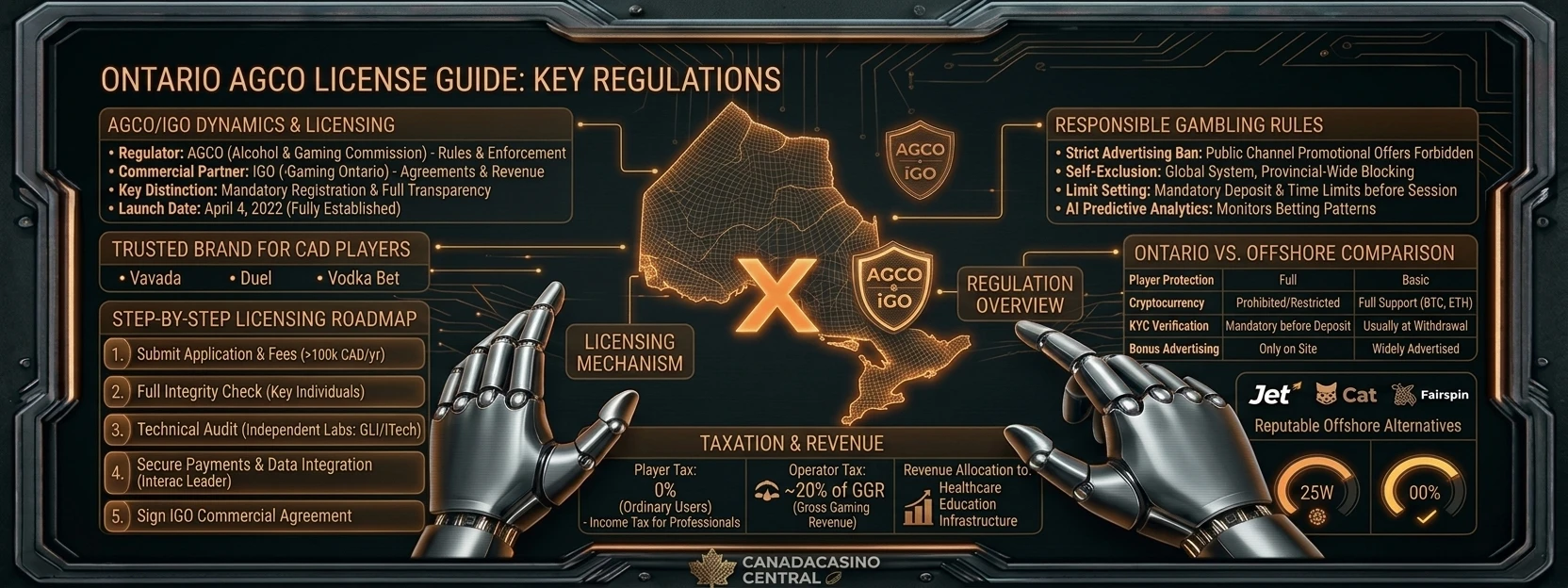
The Bottom Line: Key Facts About Regulation in Ontario
- Regulator: Alcohol and Gaming Commission of Ontario (AGCO)
- Commercial partner: iGaming Ontario (iGO)
- Launch date: April 4, 2022. As of 2026, the market is fully established and the strictest in the country.
- Key distinction: Mandatory AGCO operator registration, full financial transparency, and stringent advertising rules.
- Player status: 100% legal protection from provincial authorities.
- Trusted brands for players (CAD support): Vavada, Duel, Vodka Bet.
Welcome to Canada Casino Central. Our mission is to explain the complex legal nuances of Canadian gambling in clear, straightforward language. The province of Ontario represents a true “state within a state” when it comes to the rules governing gambling platforms.
We have examined hundreds of pages of technical standards so that you understand clearly where your money is completely safe. By 2026, gambling regulation in Ontario has reached an unprecedented level of oversight. The local system has become a model for other provinces, and to play successfully or to launch a business here, one must understand every aspect of the local legislation in detail.
Understanding AGCO and iGO Dynamics
The main mistake many newcomers make is confusing the functions of the province’s two primary bodies. Unlike most global jurisdictions where a single commission does everything, Ontario divides authority. This ensures there is no conflict of interest between supervising game fairness and collecting taxes.
This two‑tier structure makes market entry more complex for operators but maximally safe for the end consumer. Let us examine the role of each organisation in 2026 in detail.
AGCO: The Market Regulator
The Alcohol and Gaming Commission of Ontario performs an exclusively supervisory function. Its primary task is to write the rules and enforce them strictly. AGCO conducts technical audits of platforms, verifies the fairness of random number generators (RNGs), and issues basic certificates.
This commission decides whether an operator meets the highest security standards and is eligible to work in the province. An AGCO Ontario licence is issued only after a company has proven the absolute integrity of its past and present.
iGaming Ontario: The Commercial Partner
After successfully passing AGCO’s checks, an operator cannot simply start accepting deposits. It must enter into an agreement with iGaming Ontario (iGO). This body acts as a commercial bridge between business and the government.
The iGO operating agreement sets out financial terms, tax payment procedures, and dispute resolution protocols with players. The iGO logo in a site’s footer is the final confirmation for a player that an online casino is operating legally.
An AGCO licence is not just a piece of paper. It means monthly monitoring of every transaction. If a casino is operating legally in Ontario, it represents the highest mark of quality and safety in all of North America.
Licensing Process: Step‑by‑Step Guide
The path to legal status in Ontario requires significant time and financial investment. On average, the process takes six to nine months. The government carefully screens candidates, filtering out companies with questionable capital.
To give an idea of the scale of the checks, we have broken the entire mechanism into clear steps. Here is the official roadmap for entering the market:

Step 1: Operator Registration
Everything begins with submitting documents to the AGCO. At this stage, a deep integrity assessment is performed. Auditors examine sources of funding, histories of legal proceedings, and the affiliations of the founders.
AGCO operator registration is not inexpensive. In 2026, the base fee exceeds 100,000 Canadian dollars per year, which automatically excludes small “fly‑by‑night” sites.
Step 2: Technical Certification
After legal approval, the focus turns to technology. All site code, applications, and every individual slot must be certified by independent testing laboratories such as GLI or iTech Labs.
Special attention is paid to personal data protection and the integration of local banking systems to ensure a secure gateway for Canadian currency.
Step 3: iGO Agreement
The final step is signing the contract with iGO. This document sets out the operator’s obligations to remit a share of profits to the provincial budget. Only after this agreement is activated may a site open its doors to Ontario residents.
Responsible Gambling Rules
User protection requirements in Ontario are among the strictest in the world. The regulator’s core philosophy is that gambling entertainment should not become a financial trap for vulnerable populations.
Operators are required to implement predictive analytics systems. Artificial intelligence monitors betting patterns and automatically blocks an account if it detects signs of losing control over one’s bankroll.
Ban on Bonus Advertising
A unique feature of Ontario gaming standards 2026 is the strict prohibition on advertising welcome offers in public channels. You will not see banners promising “free spins” on the streets of Toronto or on social media.
Information about promotions can be obtained only after a player voluntarily visits the site and registers. This is designed to avoid provoking people into spontaneous gambling for quick gain.
Self‑Exclusion Tools
The province has a robust responsible gambling system in place. A player can click one button and block access not just to a specific site but to all legal platforms within the jurisdiction.
In addition, before each session, the system asks the player to set deposit limits and time limits for screen time. It is technically impossible to bypass these restrictions.
Taxation and Revenue Allocation
One of the most frequent questions from players concerns taxes. Much misinformation circulates online, so it is important to set the record straight. According to the laws presented on the official Ontario government portal, ordinary users do not pay income tax on their winnings.
All tax liability falls exclusively on corporations. Operators remit approximately 20% of their gross gaming revenue (GGR) to the provincial budget. These funds go toward healthcare, education, and infrastructure projects in the region.
Licensed vs Offshore Casinos: A Comparison
Despite the development of the local market, Canadian law does not explicitly prohibit users from registering on international platforms. Many experienced gamblers continue to play at legal Canadian casinos with global licences (such as Curaçao) because of a wider selection of games and more flexible limits.

Welcome Bonus
N/ARakeback 50%

Welcome Bonus
100%Up to C$1000

Welcome Bonus
100% + 30FSUp to C$450

Welcome Bonus
125% + 50FSUp to 300FS

Welcome Bonus
100% + 100FSUp to C$500
It is important to understand the risks and advantages of both approaches. The local system offers 100% payout guarantees through the courts, whereas international sites attract players with huge bonuses and the ability to use cryptocurrency.
| Parameter | AGCO Licence (Ontario) | Offshore (Curaçao / International) |
|---|---|---|
| Player protection | Full, backed by provincial law | Basic (disputes resolved by licence issuer) |
| Cryptocurrency availability | Prohibited or severely restricted | Full support for BTC, USDT, ETH |
| KYC verification | Strictly before first deposit | Usually requested at first withdrawal |
| Bonus advertising | Only inside the site itself | Widely advertised everywhere |
The choice always remains yours. If you want an absolute legal shield, look for the iGO logo. If you value cryptocurrency anonymity and high limits, reputable platforms such as Cat or Play Fortuna, which have long proven their integrity on a global level, are excellent alternatives.
Conclusion
The Ontario online casino licence has set an extremely high quality standard for the entire North American industry. The technical standards introduced in 2026 protect players from fraud and gambling addiction better than anywhere else. It is expected that Alberta will soon copy this approach.
We recommend always checking a platform’s reputation before depositing. Whether it is a local site with a regulator’s stamp or a trusted international brand such as Jet, the security of your funds must come first.
Frequently Asked Questions
Yes, absolutely legal. You may freely register and play on sites that have been approved by the AGCO and have a commercial agreement with iGaming Ontario. The law also does not penalise players for visiting international sites.
No. In Canada, gambling winnings are not considered a stable source of income. Income tax is paid only by professional gamblers for whom this is a primary business activity.
The AGCO acts as a supervisory body – it writes the rules, tests software, and penalises violations. iGO is the agency that manages the commercial side, enters into contracts with businesses, and ensures tax payments to the budget.